Adjusting just got smarter.It finds what you can’t.
LossEngine reads the policy and the carrier’s estimate, prices every line they left out, tracks every duty and deadline the policy puts on your client, and runs the statutory clock against the carrier.
Free for 14 days. No credit card. Your first analysis takes about four minutes.
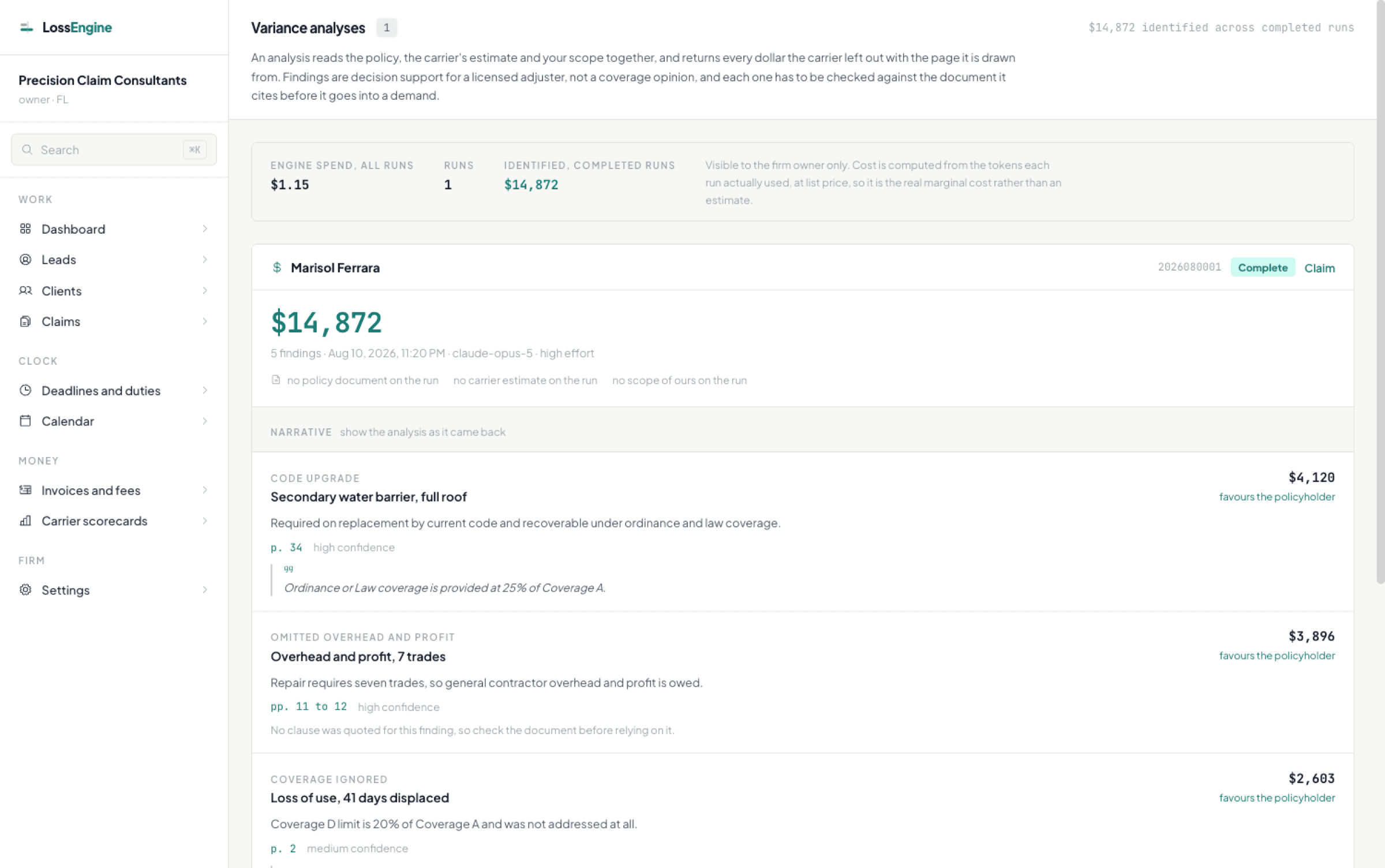
Three findings from one run. Open any of them.
What comes back
A demand exhibit, not an opinion.
Each finding names the item, prices it, and cites the page it rests on. That is the difference between telling a carrier they underpaid and showing them.
7 days
for the carrier to acknowledge a claim communication in Florida
60 days
to pay or deny, with only a 30 day regulator extension available
20% / 10%
statutory fee cap, the lower figure on declared emergency claims
Every carrier estimate is short.
You already know what is missing. The work is finding it line by line, pricing it, and tying each item back to the provision that makes it owed. On a long policy and a long estimate, that is hours per claim, and it is the part that decides what your client recovers.
LossEngine does the reading. You do the judgment. Nothing goes to a carrier that a licensed adjuster has not reviewed and signed off on.
How it works
Upload what you already have
The declarations page and policy form, the carrier's estimate, your scope, and the field photos. The policy is read once per claim and reused on every later analysis.
The engine reads all of it together
Missing line items, understated unit costs, omitted overhead and profit, depreciation applied where it should not be, code upgrade items, labor minimums, and coverage the carrier passed over.
You get an exhibit, not an opinion
Every finding carries the policy or estimate page it rests on. Review it, adjust what you disagree with, and it goes out as part of the demand.
Inside the platform
This is the actual software.
Screens from a live account. Every figure on them is computed from a real policy, a real statute, and a real carrier estimate rather than drawn for a website.
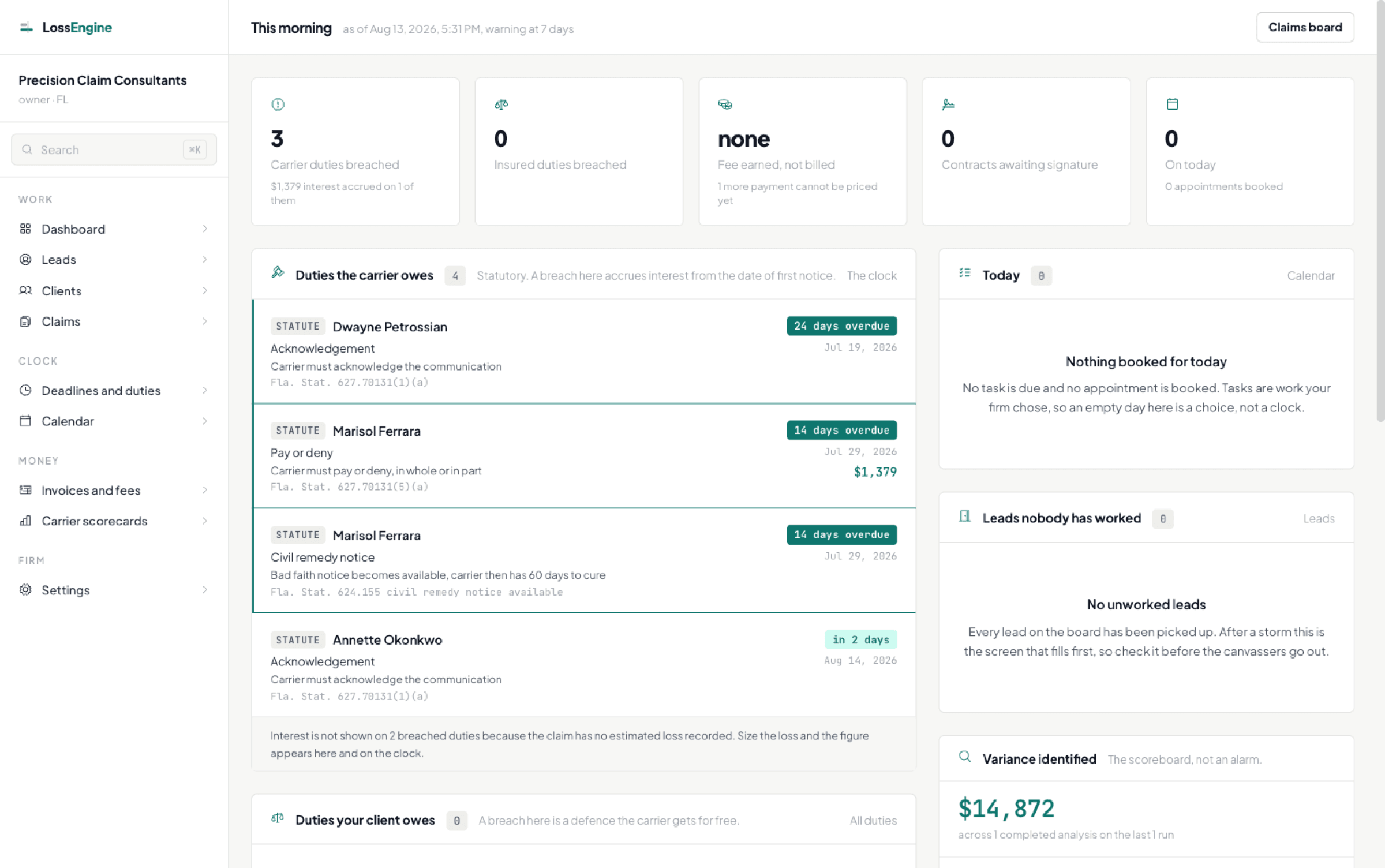
The one that matters. Sixty calendar days from notice to a decision.
Runs from first notice of loss
Computed from the verified Florida rules, with the statute on every row. A rule nobody has verified generates no date at all, which is why a state we have not signed off shows nothing rather than a guess.
Deadlines and duties. What the carrier owes under the statute, and separately what the policy puts on your client. A breach shows the interest accrued from first notice, and logging the event that answers it clears the breach.
The stack today
Five tools to work one claim.
A public adjuster pays five separate vendors to move a single file: the case manager, the photo app, Xactimate, an e signature service, and a notary. Five logins, five bills, and the claim split across all of them.
LossEngine holds four of the five and reads the fifth. Xactimate stays yours, because the estimator is not the part that is broken.
Case management
In the file
The claim, the deadlines, the documents, and the correspondence in one record.
Photo capture app
In the file
Capture on site by elevation and room, annotate, and export as a branded PDF.
Xactimate
Imported
The carrier's estimate and your own scope come in and get read. You keep the estimator.
PandaDoc or DocuSign
Partly in the file
State correct representation agreements and letters of representation are built and tracked here. Signature capture is being integrated.
The notary trip
Coming
The sworn proof of loss is built from the policy and tracked to signature. Remote notarization is not wired yet.
Variance engine
The carrier's estimate line by line against the policy and your scope. Every omission priced, every finding anchored to a page.
Statutory clock
Carrier duties and the insured's cancellation window, per state, generated from cited statute rather than dates somebody typed.
Line item reconciliation
Your scope against theirs, grouped by category, with every line reviewed by a person before it lands. Out to Excel and CSV.
Contracts and signature
State approved agreements merged from the claim, sent for signature and counter signed, with a tamper evident audit trail.
Correspondence capture
Carrier mail lands on the claim, so the email that missed a deadline sits beside the deadline it missed.
Client portal
Your client sees their own claim in your firm's name. No account, nothing about your position, and it stops the phone ringing.
Fees and invoicing
Flat, percentage, tiered, or a share of the increase over the first offer. The statutory cap is enforced when the fee is written.
Photo reports
Capture on site by elevation and room, annotate, and export as a branded PDF the carrier will actually read.
Several firms, one platform
A parent group reads across every firm it owns, and nothing outside it. Built for a book that grows by acquisition.
Consolidate on your own schedule.
Replacing the stack does not have to mean replacing it this week. LossEngine runs beside the case manager you already pay for, on the claims you choose, so there is no migration and no risk to a file you are in the middle of negotiating. Move the rest when the first claim has earned it.
Nothing to import
No file left mid transfer
Start on one claim
No chat window
Nobody should have to ask the software a question.
We reviewed a real firm's dashboard on one of the established claims platforms. The book was about 2,060 claims. Everything on that file was tracked. None of it was ranked.
This is one firm's book, not an industry figure, and the firm is not careless. It is what any busy office looks like once every event in the system becomes an alert with the same weight as every other event.
2,000
alerts flagged critical, all open at the same time, on a book of about 2,060 claims
2,100
further alerts flagged important, competing with the critical ones for the same attention
4,000
action items already past due, roughly two for every claim on the book
150
inbound emails that arrived in the system and were never opened
69%
of claims still parked in the first pipeline stage, long after intake
$5.2M
in payments recorded as received and never allocated to a claim
Four thousand undifferentiated reminders are the same as none. One statutory deadline, with the dollar interest already attached to it, is a decision you can act on this morning.
LossEngine raises fewer signals on purpose, and each one carries the money and the citation that make it worth reading. A queue nobody trusts is not a system of record. It is a liability with a login.
The alternatives
They all solve filing. None of them solve proof.
| Product | Price | What it does | Signing and notary | Named integrations | Finds the money |
|---|---|---|---|---|---|
| LossEngine | $99 per seat, published | Reads the insurance estimate against the policy and your scope, prices every omission, cites the page, and runs the statutory clock | Native e signature with a full audit trail, contract library and proof of loss workflow. Notarization still needs a notary | Xactimate ESX, CSV and PDF import | Yes |
| ClaimWizard | $99 solo only | Workflow, case tracking, documents, client communication. Pricing goes unpublished the moment you hire staff | None published | None published | No |
| ClaimRite | $99 per user | Mobile photo capture, line item management, Xactimate integration. Moves your numbers, does not challenge theirs | None published | Xactimate only | No |
| Claim Titan | Not published | Public adjuster claims management, no analytical layer | None published | None published | No |
| Clarra | Not published | Generic case management pointed at the vertical. Configurable, not knowledgeable | None published | None published | No |
| Encircle, CompanyCam | $79 to $650 | Field documentation. An input to the analysis, not the analysis | None published | None published | No |
Pricing as published by each vendor, August 2026. Unpublished tiers are noted rather than estimated. Signing, notarization, and integrations are read the same way: none of these vendors publishes e signature, remote notarization, DocuSign, PandaDoc, or an accounting connector, and only one names Xactimate at all.
Agents, not a chat box
Six agents work the file while you are on a roof.
Every one of them starts from something that happened on the claim, never from a prompt. You do not open an assistant and describe your problem. The work is already done when you open the file.
Policy reader
A policy lands
Extracts the coverage map and, more importantly, the duties after loss that policy imposes. Emits this claim's obligation schedule, because what you owe the carrier depends on what your policy reads.
Variance
A carrier estimate lands
Runs the line by line comparison against the policy and your scope, prices every omission, and posts the findings with the page each one rests on.
Clock
A date passes
Watches the statutory deadlines and the policy duties together, computes the interest a late payment has accrued, and escalates before a duty is breached rather than after.
Correspondence
Carrier mail arrives
Files it to the right claim from your connected mailbox, reads what it actually is, and closes the duty it answers. An acknowledgement satisfies the seven day duty without anyone ticking a box.
Follow up
The carrier goes quiet
Drafts and sends the next contact on schedule, so the file keeps moving on the days you are on a roof instead of at a desk.
Supplement
Scope changes
Turns new damage or a revised scope into a supplement request built from the same policy language as the original demand.
Pricing
Every price, on the page.
Solo, firm, or a hundred seats: the number is published here, not behind a quote call. Nothing metered, no charge per analysis or per signature. A single recovered line item pays for a year of it.
- One adjuster, the whole platform
- Unlimited analyses, nothing metered
- Every feature. There is no cut down solo edition
- Flat: every seat costs the same, first or fiftieth
- Unlimited analyses on every seat
- Every feature, at every headcount
- The operator layer included, at no per firm charge
- Everything the other tiers get, at volume
- Published, not quote gated. ClaimWizard prices enterprise by quote call; this rate is on the page
No card. Cancel whenever. We move your book across for free.
- Every claim, client, document and deadline
- Unlimited variance analyses. Not metered, not an add on
- The statutory clock, per state, cited to the section
- E-signature with a full audit trail, no per document fee
- Line item reconciliation, in and out to Excel
- Client portal in your firm's name
- Fees, invoicing and carrier scorecards
- Migration off ClaimWizard, done by us
Elsewhere the AI is an add on with a monthly ceiling and signatures are billed by the document. Here they are simply part of it.
Own multiple firms?
Every firm runs on its own seats above. On top of that, one portfolio view across all of them: what is open, what is breached, and what the analysis has found, firm by firm and totalled. Read only by design, because a claim file is evidence and the person who owns the firm is not the person working the file.
Billed to the group, on top of each firm’s own seats. Included at the enterprise tier.
Start on one claim.
Upload the policy and the carrier's estimate on a file you are working now. Fourteen days free, and you will know inside four minutes whether there is money on the table.
Start your 14 day trial